Sensor acquisition
Pressure, motion, temperature and humidity recorded by both insoles for later analysis.
 StrideAIContact us
 StrideOS connects device control, sensor processing and partner applications without requiring every team to rebuild the embedded stack.

Each layer has a defined job, from configuring an insole to delivering a metric inside a partner application.
Power modes, sleep timing, sensor cycles, accuracy settings, security configuration and supported wireless behavior.
Pressure, motion and environmental readings with structured export for downstream analysis.
Personal ranges, balance and load distribution, and long-term detection of meaningful changes from a person's usual movement.
Research, rehabilitation, performance, occupational and wellness workflows built from shared movement measures.
Flutter libraries, partner APIs, device fleets, application integrations and white-label delivery.
StrideOS is planned to calculate reusable measures once, then apply them in workflows appropriate to each partner and intended use.
Pressure, motion, temperature and humidity recorded by both insoles for later analysis.
Step events, cadence, speed, elevation and activity-aware processing close to the device.
Load, timing and movement differences compared with the person's own history.
Recovery, fatigue and risk-oriented summaries developed for defined research or professional workflows.
The roadmap groups applications by workflow rather than presenting every possible use case as a separate product.
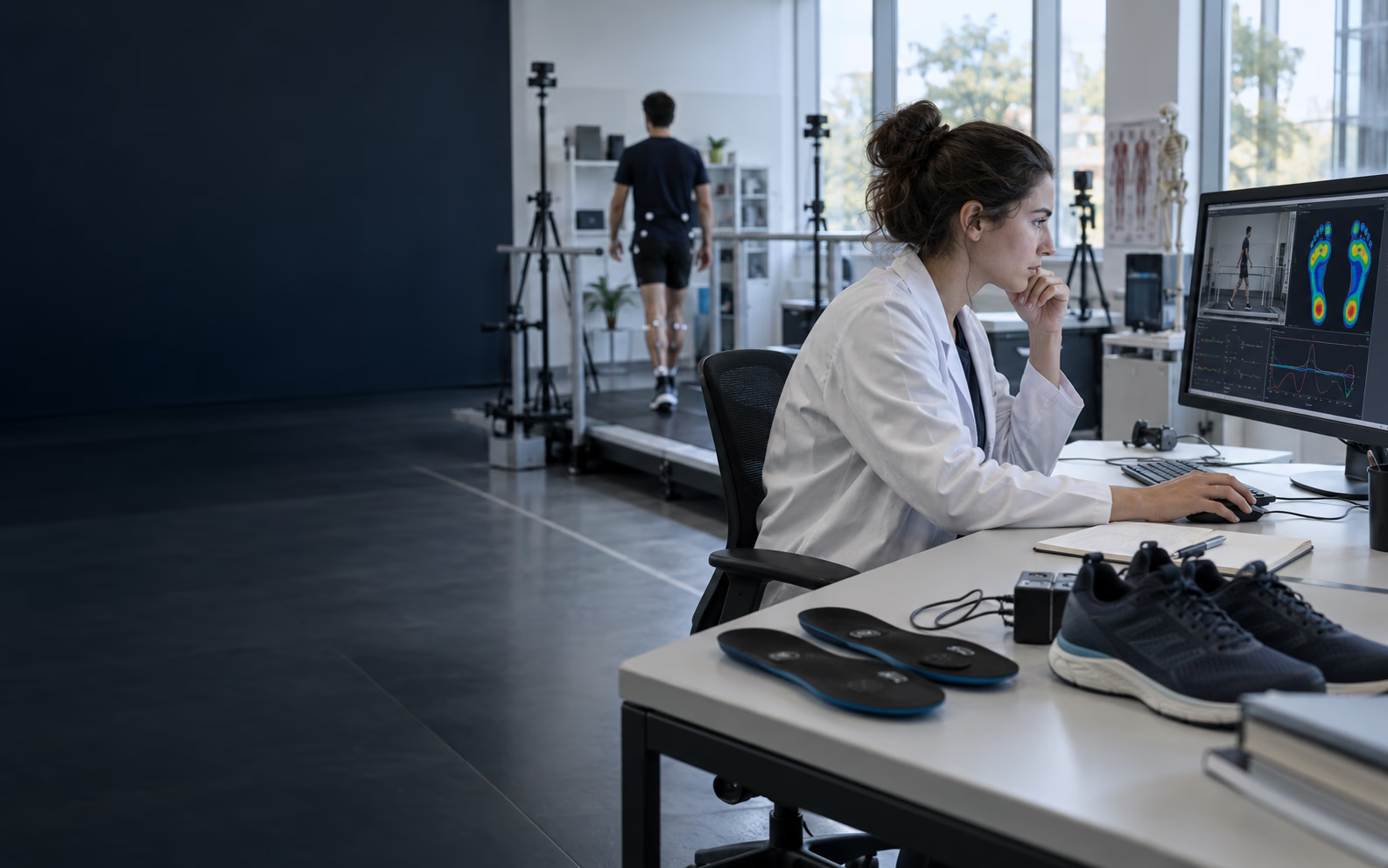
Raw and processed signals, annotations, study cohorts, exports and algorithm version records.

Weight-bearing targets, adherence, recovery trends drawn from sensor fusion and movement history, and between-visit review.

Movement baselines, workload, impact exposure and fatigue-related change.

Standing exposure, cumulative load, carried-load context and device fleet reporting.

Personal movement trends and evidence-based feedback without disease-specific claims.
StrideAI already applies these engineering practices throughout development, building the records, traceability and technical documentation needed for future partner certification.
We use the ISO 14971 standard to connect hazards with controls and measurable requirements, and IEC 62366-1 to address use-related risk.
We apply IEC 62304 practices across architecture, implementation, verification, traceability, maintenance and problem resolution.
IEC 60601-1 principles inform our work on basic safety and essential performance. IEC 81001-5-1 guides threat analysis, communications, update integrity and vulnerability management.
Firmware is developed using MISRA-compliant coding, supported by static analysis, configuration control, fault-injection testing, watchdogs, range checks, explicit invalid-data states, strong peer review and testing procedures.
Formal certification has not yet been submitted. Once a partner product, intended use and target market are defined, the evidence and documentation produced through this process can form the basis of a submission to the relevant certification or regulatory body.
Flutter integration libraries support Android, iOS, Windows, macOS, Linux and the web. Qualified partners can discuss hardware control, data access and application requirements.
Explore partner integration